10. Inspiration – 3 books about coaching and not only for coaches

“Happiness cannot be pursued; it must ensue.” – Viktor E. Frankl

1. Book: Learned optimism by Martin Seligman, PhD
1.1 About the Book

Introduction
Learned Optimism by Martin Seligman is a highly practical psychology book that connects research with everyday life. Across the chapters, it shows that the way people explain setbacks shapes helplessness, resilience, depression, achievement, health, parenting, school performance, sport, and work. The central message is powerful: optimism is not naive cheerfulness, but a learnable way of interpreting adversity that can improve action, persistence, and well-being.
Chapter 1 explains that the key difference between optimism and pessimism is how people explain setbacks. Pessimists tend to see bad events as permanent, widespread, and personal, while optimists see them as temporary, specific, and often caused by circumstances. The chapter connects this difference to helplessness, depression, achievement, health, and personal control, and argues that optimism can be learned.
 | 3 main takeaways for learning
|
Chapter 2 explains how learned helplessness was discovered. Dogs exposed to inescapable shock later stopped trying to escape even when escape was possible, as if they had learned that nothing they did mattered. The chapter then shows that helplessness can be cured by relearning control and prevented through earlier experiences of mastery. It also extends this idea to people and argues that resilience can be learned.

3 main takeaways for learning from Chapter 2
Control matters.
When people or animals experience that their actions do not change outcomes, they may stop trying.
Helplessness is learned, so it can be unlearned.
The chapter shows that giving-up behavior is not fixed; it can be reversed through new experiences of effectiveness.
Resilience can be built.
Earlier experiences of mastery can protect against later helplessness, which means resilience is developable.
Chapter 3 explains explanatory style: the habitual way people explain why bad and good events happen. Seligman argues that the key difference between people who stay helpless and those who recover is not the setback itself, but how they interpret it. He introduces three dimensions of explanation—permanence, pervasiveness, and personalization—and shows that these shape hope, self-esteem, helplessness, and resilience. The chapter also presents a questionnaire to measure optimism and pessimism.

3 main takeaways for learning from Chapter 3
How you explain events shapes your resilience.
The same setback can lead to helplessness or recovery depending on your explanatory style.
Hope comes from temporary and specific explanations.
When you see bad events as limited in time and scope, they are less likely to spread into despair.
Optimism is measurable and changeable.
The chapter shows that explanatory style can be identified and later improved, which makes it useful for learning and practice.
Chapter 4 links pessimism and depression more directly. Seligman explains that depression can be seen as pessimism enlarged, and describes how depressed thinking shows up in thought, mood, behavior, and physical symptoms. He also argues that learned helplessness is a strong model for depression, because both share the same core pattern: the belief that nothing you do will matter.

3 main takeaways for learning from Chapter 4
Depression is deeply connected to pessimistic thinking.
Seeing bad events as permanent, pervasive, and personal strengthens despair.
Helplessness is central.
When people believe their actions will not work, passivity, hopelessness, and low energy grow.
Explanatory style matters even more.
The chapter points toward hope: how people explain failure can influence whether helplessness deepens or changes.
Chapter 5 explains that depression is strongly shaped by conscious thought and presents cognitive therapy as an effective way to change it. Seligman highlights the work of Albert Ellis and Aaron Beck, arguing that pessimistic explanatory style and rumination help turn failure into depression. Cognitive therapy works by teaching people to notice automatic negative thoughts, challenge them, create better explanations, reduce rumination, and change the assumptions that keep depression alive.

3 main takeaways for learning from Chapter 5
Thoughts shape feelings.
The chapter argues that how you think about failure, loss, and helplessness can either deepen depression or reduce it.
Pessimism plus rumination is a dangerous combination.
When people explain bad events as personal, permanent, and pervasive, and keep brooding on them, depression grows more easily.
Thinking habits can be changed.
Cognitive therapy works by teaching practical skills: spot automatic thoughts, challenge them with evidence, reattribute causes, distract from rumination, and question unrealistic assumptions.
|  |
3 main takeaways for learning from Chapter 6
Optimism improves persistence.
In difficult work, especially where rejection is common, optimists recover faster and keep acting.
Success is not just talent.
The chapter argues that performance depends on three things: ability, motivation, and optimism.
Use flexible optimism.
Optimism is powerful for action and growth, but realism still matters in situations that require caution, accuracy, and risk awareness.
Chapter 7 explains that explanatory style begins in childhood and is shaped mainly by what children hear from parents, how adults criticize them, and how early crises unfold. Seligman argues that children learn optimism or pessimism from the explanations around them, especially from the primary caregiver, and that early losses or repeated unresolved hardship can plant the seeds of hopelessness. At the same time, early experiences of recovery and change help children learn that bad events are temporary and manageable.

3 main takeaways for learning from Chapter 7
Children learn how to explain life from adults.
The way parents explain setbacks and problems becomes a model children absorb.
Criticism should be specific and temporary.
Feedback like “you didn’t try hard enough this time” is less damaging than labels like “you’re lazy” or “you’re stupid.”
Early adversity does not only hurt; it teaches a pattern.
If a child sees crises improve, they can learn hope. If hardship feels permanent and pervasive, pessimism can take root.
|  |
3 main takeaways for learning from Chapter 8
Explanatory style affects school performance.
Children who explain setbacks as temporary and specific recover and persist more than those who see failure as permanent and pervasive.
Depression can block learning.
A child may perform poorly not because of low ability, but because depression reduces effort, persistence, and risk-taking.
Family environment matters a lot.
Parental conflict, separation, and repeated bad life events can intensify pessimism and school problems, so children need extra support during those periods.
Chapter 9 shows that optimism improves sports performance, especially under pressure and after defeat. Seligman argues that athletes and teams with a more optimistic explanatory style perform better because they recover faster, try harder, and do not fall apart after losses. He supports this with studies from baseball, basketball, and Berkeley swimming, showing that optimism predicts success beyond raw talent alone.

3 main takeaways for learning from Chapter 9
Optimism helps people bounce back.
In sport, the real test is often what happens after a setback. Optimists recover and respond better.
Teams also have an explanatory style.
The chapter shows that not only individuals, but whole teams can develop an optimistic or pessimistic pattern that affects performance.
Mental style can improve results.
Talent matters, but mindset changes performance under challenge, and pessimistic athletes can be trained toward optimism.
 |
|
3 main takeaways for learning from Chapter 10
Mind and body are linked.
The chapter argues that psychological states are not just emotional; they can influence physical health through biological pathways such as the immune system.
Control protects health.
Experiences of mastery, choice, and action appear healthier than helplessness and passivity, both in animal studies and human settings.
Explanatory style may become a health factor.
Optimism seems to support healthier behavior, better immune functioning, and better long-term outcomes, which makes thinking style important beyond mood alone.
|  |
3 main takeaways for learning from Chapter 11
Explanatory style can be studied beyond individuals.
The chapter shows that optimism and pessimism are not only personal traits; they can be measured in leaders, cultures, religions, and historical documents.
Hope may influence collective outcomes.
In politics especially, more optimistic speech often created more hope, stronger campaigning, and better electoral results.
Psychology can help predict history.
Seligman argues that with valid principles, blind scoring, and large enough samples, psychology can move from explaining the past to forecasting real events.
Chapter 12 explains how to change pessimistic thinking into learned optimism in daily life. Seligman presents flexible optimism, not blind positivity: use optimism when you need resilience, action, morale, health, or leadership, but avoid it when the cost of failure is high and realism matters more. The chapter then teaches practical methods such as the ABC model, disputation, distraction, and ABCDE practice so people can challenge automatic negative beliefs and respond to adversity with more energy and hope.

3 main takeaways for learning from Chapter 12
Thoughts about adversity shape emotions and action.
The chapter shows that beliefs, not events alone, drive giving up or moving forward.
Pessimistic beliefs can be challenged.
Disputation helps by testing beliefs with evidence, alternatives, implications, and usefulness.
Optimism should be used wisely.
The goal is not permanent positivity, but choosing optimism when it helps and realism when risk is high.
|  |
3 main takeaways for learning from Chapter 13
Children can unlearn pessimism.
Pessimism is not fixed; children can develop more hopeful and realistic explanations for setbacks.
Parents can teach optimism directly.
The chapter presents parents as active coaches who help children notice thoughts, challenge them, and build healthier inner dialogue.
Practice matters more than theory.
Children learn these skills best by using real-life examples, daily ABC or ABCDE records, and repeated disputation of self-criticism.
Chapter 14 explains how an organization can use optimism at work. Seligman says optimism helps people get past the “wall” of discouragement, especially in difficult, rejection-filled jobs. He describes three organizational uses of optimism: selecting optimistic people, placing people in roles that fit their style, and teaching employees to learn optimism through the ABCDE model, disputation, and better internal dialogue.

3 main takeaways for learning from Chapter 14
Optimism is a work skill.
It is not only personality; it can directly affect persistence, morale, and performance when work gets hard.
Different jobs need different styles.
Some roles need bold persistence and initiative, while others need caution, realism, and accurate judgment.
Negative self-talk can be trained.
The chapter shows that by noticing adversity, beliefs, and consequences, then disputing pessimistic thoughts, people can move from passivity to energy and action.
|  |
3 main takeaways for learning from Chapter 15
Meaning protects mental health.
A life focused only on the self becomes fragile. People need connection to something larger than themselves.
Optimism is a tool, not a religion.
Learned optimism helps reduce depression, improve health, and support action, but it should be used wisely.
The wisest stance is flexibility.
There are moments to dispute pessimistic thoughts, and moments to face reality directly. Healthy thinking means being able to choose.
1.2 Interesting insights
One of the most interesting insights in the book is that the same event can produce very different outcomes depending on a person’s explanatory style. Seligman shows that pessimism is not just a mood but a pattern of interpretation: seeing problems as permanent, pervasive, and personal. Another strong insight is that helplessness is often learned through repeated lack of control, but it can also be unlearned through mastery and new experience. The book is also especially interesting because it applies the same core idea across many domains: depression, cognitive therapy, childhood, school, sport, health, leadership, and workplace performance. That makes the book feel broad, coherent, and memorable.
1.3 What makes a book good
The book is good because it combines clear theory, research stories, and practical tools. It does not stay abstract. Instead, it gives readers models such as explanatory style, the ABC/ABCDE method, disputation of beliefs, and flexible optimism. It is also strong because it is relevant to many kinds of readers: coaches, parents, teachers, leaders, and people working on their own mental resilience. Even today, its basic message still fits well with modern cognitive-behavioral thinking, especially the idea that thoughts influence feelings and behavior, and that these thought patterns can be changed. APA still describes CBT as a treatment that works by changing the relationship between thoughts, feelings, and behaviors, which is closely aligned with one of the book’s strongest contributions.
1.4 What is the shortcoming of the book
Shortcomings of the book, and what is still considered correct
The main shortcoming of the book is that some claims are stronger and broader than current science would state today. The core ideas that still hold up well are these: pessimistic explanatory style is linked to depressive symptoms; optimism is associated with better coping and often better health and functioning; optimism and pessimism can change over time; and cognitive methods can help people challenge unhelpful thoughts. Recent studies still support links between optimism and adaptive coping, health, cognitive functioning, and depressive symptoms.
What is less secure today is the book’s tendency to present optimism as a very wide-ranging explanation for many outcomes. Modern psychology usually treats depression and resilience as multifactorial, involving biology, environment, relationships, stress exposure, and social conditions, not just explanatory style alone. Also, some of Seligman’s early claims about direct immune-system effects and broad predictive power should be read more cautiously today; the overall association between optimism and health is real, but typically modest and mediated partly by behavior and coping rather than by a simple one-step cause. Researchers also emphasize that optimism and pessimism are not always exact opposites and may follow partly different pathways.
Another limitation is that the book can sometimes sound as if optimism is almost always better. Current thinking is more nuanced. There is still support for flexible or rational optimism, but researchers also note that realism matters, and that optimistic beliefs can carry costs in some contexts. In that sense, one of the book’s later messages, “use optimism wisely,” has actually aged better than a simple “be positive” reading would suggest.
1.5 Conclusion
Overall, Learned Optimism remains an important and useful book because its main insight still matters: how people explain adversity influences whether they give up or keep going. Some of its stronger claims now need more nuance, but the book’s lasting value is clear. It helped popularize the idea that helplessness is learned, that thinking patterns can be changed, and that optimism works best not as blind positivity, but as a flexible skill joined with realism, evidence, and action.
2. Book: Good Business, Leadership, Flow, and the Making of Meaning By Mihaly Csikszentmihalyi
2.1 About the Book
Introduction
This book presents business not only as an economic activity, but as a human and moral one. Across the nine chapters, it connects work, happiness, flow, leadership, purpose, and responsibility. The core message is clear: good business should create value not only for profit, but also for people, meaning, growth, and society.
Here is a short summary of Chapter 1
|  |
3 main takeaways for learning from Chapter 1
Leadership is more than financial performance.
A strong leader should also care about people, purpose, and the wider impact of the organization.
Long-term thinking matters.
The chapter values “hundred-year managers” who build lasting value instead of chasing only quarterly results.
Meaningful work supports well-being.
People do better when their work uses their strengths, feels worthwhile, and contributes to something beyond profit.
Chapter 2 explains that business and happiness are closely connected because people buy products and services in the hope that they will improve life. The chapter argues that money and possessions help only up to a point; beyond basic needs, happiness depends more on relationships, meaningful work, growth, contribution, and using one’s abilities well. It also distinguishes between “good business,” which genuinely supports human well-being, and “bad business,” which stimulates false desires, addiction, deception, or empty materialism. The chapter’s deeper message is that real happiness grows from both individual development and connection to something larger than oneself.

3 main takeaways for learning from Chapter 2
Money is not enough.
After basic needs are covered, more possessions do not guarantee greater happiness.
Real value supports human growth.
The best work, products, and organizations help people develop, contribute, and live more meaningfully.
Happiness needs both self and others.
A good life combines personal strengths and uniqueness with relationships, service, and belonging.
Chapter 3 explains that real happiness is not passive comfort but active enjoyment. The chapter centers on flow: a state of deep involvement in which people are fully focused, challenged, and absorbed in what they are doing. Unlike simple pleasure, which brings comfort and satisfies existing needs, flow helps people grow because it requires skill, effort, and full attention. The chapter shows that flow can happen in work, art, sport, relationships, and even ordinary daily activities when goals are clear, feedback is immediate, and challenge matches ability. In this view, happiness comes less from rewards and more from doing meaningful activity well for its own sake.

3 main takeaways for learning from Chapter 3
Growth needs challenge.
People feel most alive when they stretch their abilities instead of staying only with comfort and ease.
Deep focus improves experience.
Clear goals, concentration, and immediate feedback make work and learning more engaging and satisfying.
Meaningful action matters more than external reward.
The chapter highlights autotelic activity: doing something because the activity itself is worth doing, not only for money, praise, or status.
Chapter 4 explains that flow supports long-term growth, not just momentary enjoyment.
|  |
3 main takeaways for learning from Chapter 4
Keep increasing the challenge.
To stay engaged and keep growing, raise the level of challenge as your skill improves.
Attention is your most important resource.
What you focus on shapes your learning, skills, and quality of life, so attention should be used deliberately.
Growth needs the right environment.
People develop best when work and life provide support, variety, responsibility, and room to learn.
 | Chapter 5 explains why flow is often missing at work even though people are naturally built to enjoy purposeful effort.
|
3 main takeaways for learning from Chapter 5
Design matters.
Flow is less likely when work lacks clear goals, feedback, autonomy, and a good skill-challenge balance.
Meaning matters.
People engage more deeply when they understand why the work matters and feel it creates real value.
Attitude matters too.
The same job can be experienced as dull labor or as a vocation, depending on how a person approaches it and how the workplace supports that mindset.
Chapter 6 explains how leaders can build organizations that make flow more likely.
|  |
3 main takeaways for learning from Chapter 6
Leadership means enabling people.
A strong manager creates an environment where employees can contribute, learn, and do excellent work together.
Flow needs structure and freedom.
People need clear goals and feedback, but also enough autonomy and trust to choose how to do the work well.
Culture shapes performance.
Physical setting, communication, values, and the way people are treated all influence whether work feels deadening or alive.
 | Chapter 7 explains that good working conditions and flow are not enough by themselves.
|
3 main takeaways for learning from Chapter 7
Meaning creates stronger motivation.
People work harder and better when they feel connected to a purpose larger than pay or promotion.
Leadership needs both vision and character.
The chapter highlights integrity, optimism, perseverance, curiosity, and empathy as qualities that help leaders inspire others.
Good business serves beyond itself.
A strong organization does not exist only for owners or profit; it also contributes to employees, customers, community, and the wider world.
Chapter 8 explains that creating flow in life begins with knowing yourself and defining what truly matters
|  |
3 main takeaways for learning from Chapter 8
Know yourself before choosing your direction.
A meaningful life and authentic leadership start with understanding your values, strengths, and the kind of person you want to become.
Manage attention, time, and habits deliberately.
The chapter shows that flow depends on how you invest your psychic energy day by day.
Choose work and life settings that help you grow.
The right environment should not only pay you, but also support your talents, values, learning, and long-term development.
 | Chapter 9 asks whether business can keep its power and legitimacy if it serves only profit and ignores human well-being.
|
3 main takeaways for learning from Chapter 9
Business needs moral legitimacy, not only profit.
If organizations care only about returns and ignore fairness, human impact, and the common good, they risk losing society’s trust and support.
Visionary leadership joins excellence with service.
The chapter highlights three strong callings: doing one’s best, helping people, and contributing to a better world.
Good business is built in daily practice.
Trust, respect, growth, flow, and responsible products are not slogans; they must show up in how people are led, how work is organized, and what the company actually brings into the world.
2.2 Interesting insights
One of the most interesting insights is how strongly the book links flow with both individual well-being and organizational quality. It shows that people do not thrive only through pleasure or pay, but through meaningful challenge, deep focus, growth, and contribution. Another strong insight is that leadership is presented as the creation of conditions: clear goals, feedback, trust, autonomy, and purpose. The book also goes beyond workplace design by arguing that even good systems are not enough without a “soul of business” — a deeper reason for serving others and contributing beyond self-interest. This makes the book richer than a standard management text because it connects psychology, ethics, and leadership in one framework.
2.3 What makes a book good
The book is good because it combines big ideas with practical relevance. It explains complex concepts like flow, meaning, challenge, growth, and business responsibility in a way that is understandable and useful. It is also strong because it does not reduce people to productivity tools. Instead, it treats human attention, purpose, dignity, and character as central to both good work and good leadership. That gives the book both intellectual depth and lasting practical value.
2.4 What is the shortcoming of the book
Shortcomings of the book / what is still considered correct in Flow
The strongest part of the book that is still well supported today is the basic idea of flow as a state of deep absorption, concentration, intrinsic enjoyment, and reduced self-consciousness, typically helped by clear goals, immediate feedback, and a strong sense of control. These core features are still widely used in current flow research, and the field remains active across psychology, education, sport, work, music, health, and technology. Recent reviews also support the importance of attention, motivation, and rewarding task engagement in flow experiences.
At the same time, one shortcoming is that some parts of flow theory are less settled than the book may suggest. Current research says the concept is still valuable, but the field has struggled with inconsistent definitions and measurement; one major review found that recent studies operationalized flow in many different ways, which makes comparison harder. Researchers also continue to debate how exact the classic “challenge-skill balance” idea is, because it does not always predict flow in a simple or uniform way across contexts. In other words, the core intuition of flow remains strong, but some details of the theory are more complex and less universally confirmed than earlier presentations implied.
2.5 Conclusion
Overall, the book remains a thoughtful and inspiring work because it argues that business is at its best when it supports human flourishing. Its strongest contribution is the way it joins performance with meaning, and leadership with responsibility. Even where flow theory has been refined by later research, the book’s main message still holds: people and organizations do better when work is meaningful, challenging, well-designed, and connected to something larger than profit alone.
3. Book: Flourish by Martin Seligman, PhD
3.1 About the Book

Introduction
Flourish presents Martin Seligman’s move from a narrow focus on happiness toward a broader understanding of well-being. Across the ten chapters, the book shows that flourishing is built through PERMA, practical interventions, character strengths, resilience, positive education, health assets, and a wider social vision of what makes life worth living.
Chapter 1 explains the shift from thinking about happiness as the goal of positive psychology to thinking about well-being as the real goal. Seligman argues that happiness is too narrow and too tied to mood. Instead, he presents well-being theory, which says that flourishing comes from five elements: positive emotion, engagement, relationships, meaning, and accomplishment. Together these form the PERMA model. The chapter also shows that positive psychology should not only ask how people feel, but also how fully they are living and functioning.
Seligman moves beyond the older idea of happiness theory.
Happiness alone is seen as too limited and too dependent on mood.
Well-being is made of five elements: PERMA.
P = Positive emotion
E = Engagement
R = Relationships
M = Meaning
A = Accomplishment
The goal of positive psychology becomes flourishing, not just feeling good.

3 main takeaways for learning from Chapter 1
Feeling good is only one part of a good life.
A strong life also includes purpose, connection, achievement, and deep involvement.
Well-being is broader than happiness.
You can have meaning, relationships, and accomplishment even when you are not in a cheerful mood.
Flourishing can be understood in practical elements.
The PERMA model gives a clear framework for building a better life and supporting growth in coaching, education, and personal development
Chapter 2 focuses on positive psychology exercises that actually work. Seligman asks whether well-being can be changed in a lasting way and argues that some activities can genuinely raise happiness and lower depression. The chapter presents evidence-based interventions such as the gratitude visit, what-went-well / three blessings, and using signature strengths in new ways. It also shows that these exercises were tested scientifically and that some produced benefits lasting for months, especially when people kept practicing them.

3 main takeaways for learning from Chapter 2
Well-being can be trained through practice.
Happiness is not only luck or circumstances; some intentional exercises can improve it.
Simple actions can have strong effects.
Writing gratitude, noticing what went well, and using strengths more deliberately can meaningfully improve mood and outlook.
Practice matters more than one-time inspiration.
The chapter shows that benefits last longer when people continue doing the exercises, not when they try them only once.
| 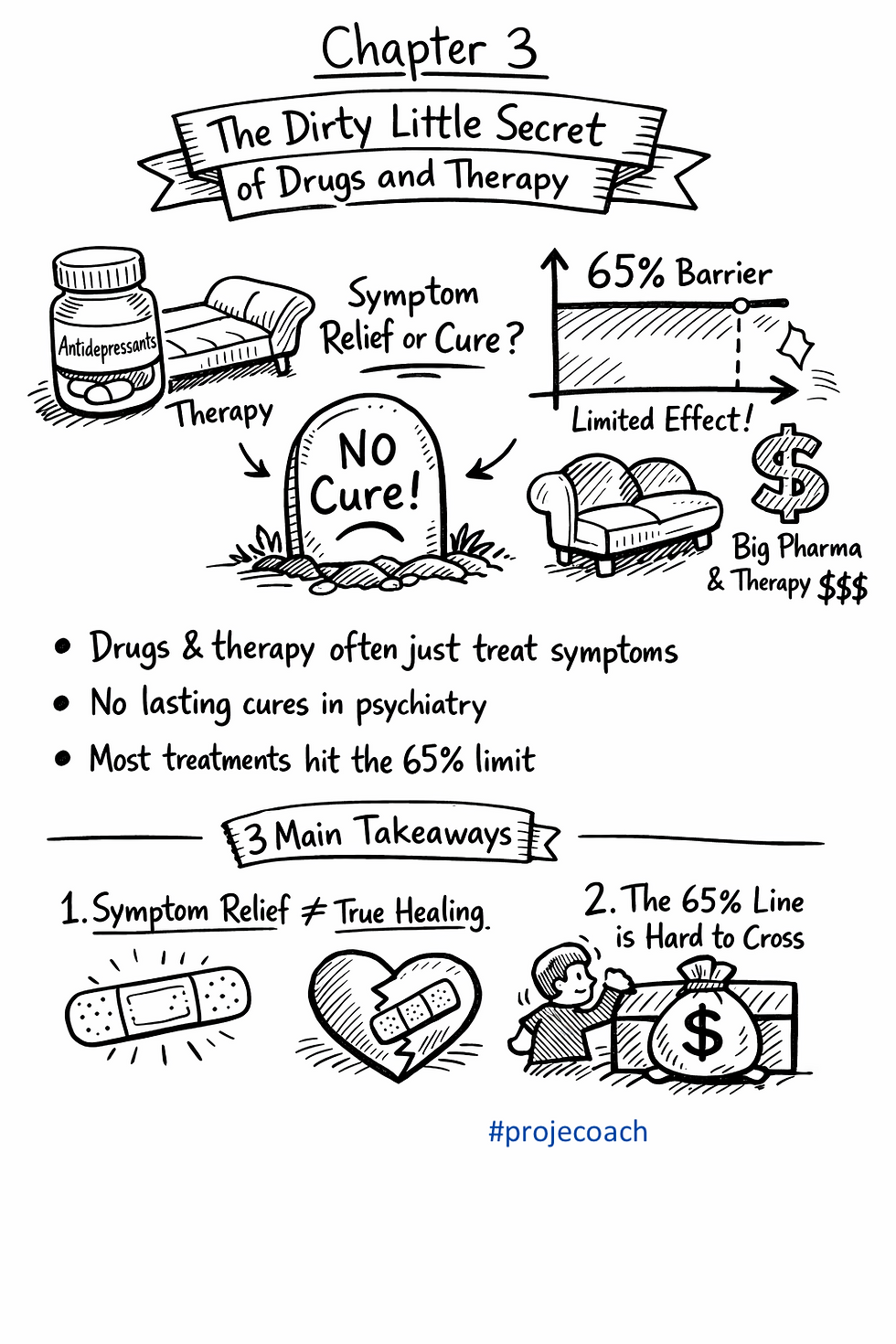 |
3 main takeaways for learning from Chapter 3
Relief is not the same as flourishing.
Reducing sadness, anxiety, or depression is important, but it does not automatically create meaning, strong relationships, or a fulfilling life.
People need skills for functioning during difficult emotions.
The chapter stresses learning to live effectively even when sadness, fear, or anger are still present.
Positive psychology adds the enabling side of life.
Real growth comes not only from removing problems, but also from building strengths, relationships, accomplishment, and meaning.
 |
|
3 main takeaways for learning from Chapter 4
Well-being can be taught.
Education can help people build positive emotion, meaning, relationships, and accomplishment, not only knowledge and job skills.
The best learning is transformative.
Chapter 4 shows that learning is strongest when it is intellectually rich, personally relevant, and energizing.
Coaching is stronger when grounded in science.
Seligman argues that positive psychology can give coaching clearer theory, better measures, and more responsible practice boundaries.
|  |
3 main takeaways for learning from Chapter 5
Well-being should be taught early.
Schools should not focus only on grades, discipline, and job preparation. They can also teach resilience, optimism, strengths, and meaning.
Better feeling can support better learning.
The chapter shows that positive mood is linked with broader thinking, creativity, enjoyment of school, and stronger engagement.
Culture matters, not only lessons.
Positive education works best when it is not just a single class, but part of everyday school life, teacher behavior, language, and relationships.
 |
|
3 main takeaways for learning from Chapter 6
Achievement is more than IQ.
Being smart helps, but long-term success depends heavily on effort, self-control, and persistence.
Deliberate practice matters.
Time on task builds knowledge, automatic skill, and better performance, even when natural talent is not exceptional.
Grit and self-discipline can change results.
The chapter suggests that character strengths are not side issues; they are central drivers of real-world achievement and flourishing.
|  |
3 main takeaways for learning from Chapter 7
Psychological fitness should be trained proactively.
The chapter shows that it is better to build resilience before breakdown than to focus only on treatment afterward.
Strengths can be measured and developed.
The GAT does not only look for weakness; it also identifies assets and uses them to guide learning and improvement.
Resilience is social, emotional, family-based, and spiritual.
Strong performance under stress depends not only on the individual mind, but also on relationships, purpose, trust, and support systems.
Chapter 8 contrasts post-traumatic stress disorder (PTSD) with post-traumatic growth (PTG). Seligman argues that after severe adversity, the most common human response is often resilience, and in some cases people later grow beyond their previous level of functioning. The chapter explains that trauma can shatter beliefs about self, others, and the future, but growth becomes more likely when people reduce anxiety, talk constructively about the trauma, build a meaningful trauma narrative, and identify new strengths, deeper relationships, renewed appreciation of life, and new priorities. It also describes how the Army’s resilience training was designed to move soldiers not only away from PTSD, but toward resilience and growth.

3 main takeaways for learning from Chapter 8
Trauma does not lead only to damage.
Adversity can produce pain and distress, but it can also become the starting point for resilience and growth.
Meaning-making matters after trauma.
Growth is supported when people tell the story, reflect on what changed, and build a stronger life narrative from the experience.
Psychological skills can shift outcomes.
The chapter shows that optimism, perspective, constructive disclosure, and relationship skills can help reduce downward spirals and increase the chance of post-traumatic growth.
| 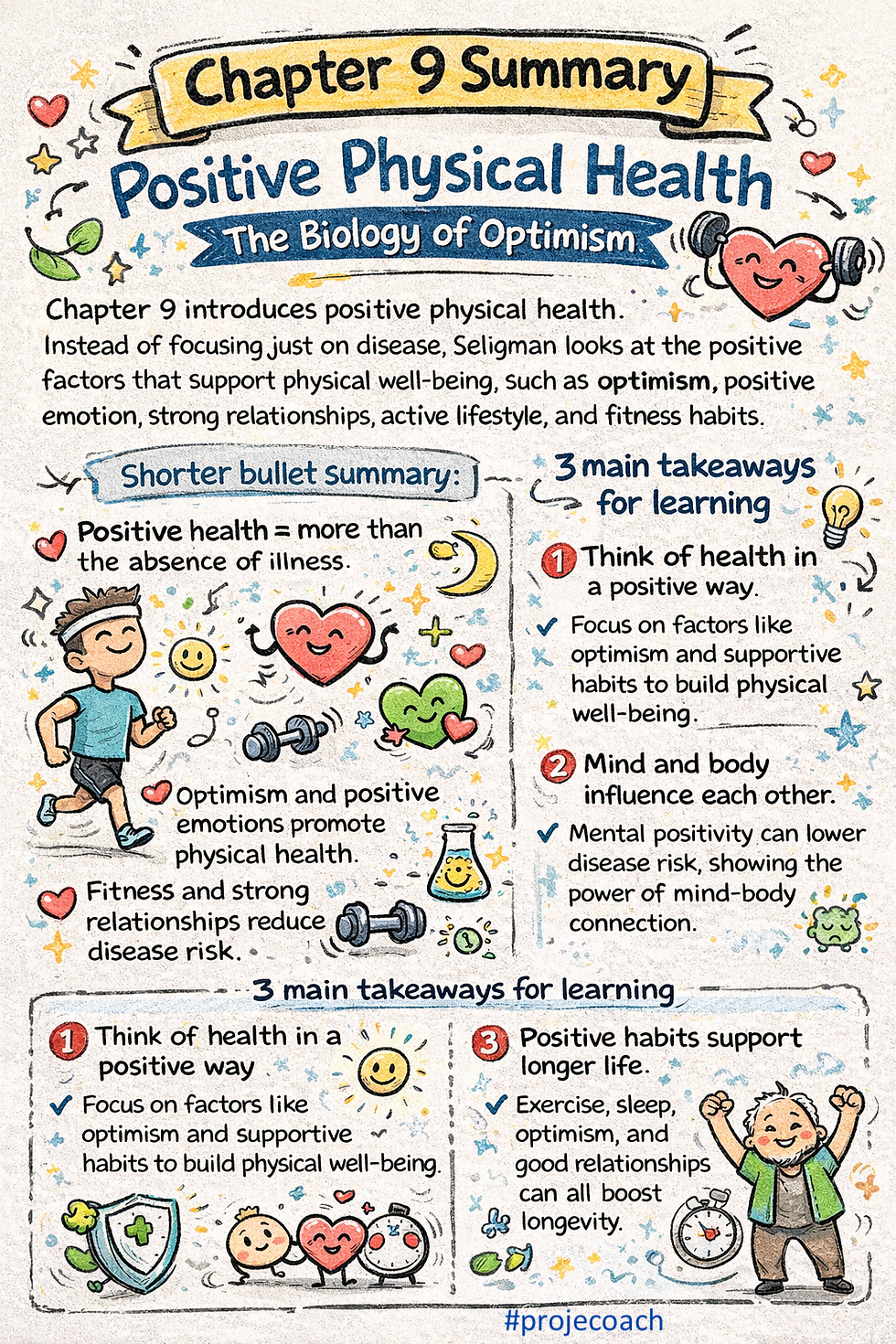 |
3 main takeaways for learning from Chapter 9
Health should be viewed positively, not only defensively.
The chapter shows that medicine and psychology often focus too much on reducing problems and too little on building strengths that protect health.
Optimism and positive emotion may influence the body.
Seligman presents evidence that mindset is not only psychological; it may affect cardiovascular outcomes, infectious illness, and long-term survival.
Exercise is one of the strongest practical health assets.
The chapter emphasizes that becoming more active is a realistic and powerful way to improve health, and that fitness may matter more than thinness alone.
Chapter 10 argues that wealth is not the same as well-being and that modern societies should stop using GDP alone as the main sign of progress. Seligman says money matters, especially below a basic safety level, but once basic needs are met, more wealth brings diminishing returns for life satisfaction and does not necessarily improve mood, meaning, relationships, or flourishing. He criticizes GDP because it can rise even when quality of life worsens, and he proposes a broader public goal: measuring and building well-being through PERMA rather than focusing only on money. The chapter ends with a large mission for positive psychology: increasing the number of people who are flourishing in the world.

3 main takeaways for learning from Chapter 10
Money is a means, not the final goal.
Wealth should serve human well-being, not replace it as the main purpose of policy or life.
What we measure shapes what we pursue.
If governments measure only GDP, policy will chase money; if they also measure well-being, policy can support healthier, more meaningful lives.
Flourishing is broader and more democratic than happiness alone.
Seligman argues that well-being should include not only subjective feeling, but also meaning, relationships, and accomplishment, with both subjective and objective aspects.
3.2 Interesting insights
One of the most interesting insights in the book is that well-being is not just a feeling but a multidimensional way of functioning. Seligman connects inner life with education, therapy, health, achievement, trauma, institutions, and even economics. Another strong insight is that positive psychology is not only about “thinking positively,” but about measurable skills and habits: gratitude, strengths use, resilience, meaning-making, and constructive relationships. The book is also interesting because it widens success beyond IQ, treatment beyond symptom relief, and progress beyond GDP.
3.3 What makes a book good
The book is good because it combines theory, research, and practical application in a very accessible way. It offers a clear framework through PERMA, gives memorable real-world examples, and shows how the ideas can be used in coaching, schools, health, the military, and public policy. Its strength is that it is both inspiring and structured, so the reader gets not only ideas, but also useful directions for practice.
3.4 What is the shortcoming of the book
The strongest parts of Flourish that still hold up well are its broad shift from “happiness” to multidimensional well-being, the practical value of strengths, gratitude, resilience, and the idea that flourishing includes meaning, relationships, engagement, and accomplishment, not just positive mood. PERMA also remains widely used as a practical organizing framework, and gratitude-based interventions still show small but reliable benefits for well-being in modern reviews. At the same time, some of the book’s limits are clearer today: critics argue that parts of positive psychology can be too individual-focused, sometimes underestimating culture, inequality, and life context, and PERMA itself is often criticized for overlap with older well-being models rather than being fully distinct. Much of the evidence around PERMA is also correlational and self-report based, so it works better as a helpful framework than as a final scientific map of flourishing.
3.5 Conclusion
Overall, Flourish is an important and influential book because it helped redefine positive psychology around well-being rather than simple happiness. Its lasting contribution is the message that flourishing can be understood, practiced, and supported at personal, educational, organizational, and societal levels. Even where the science has become more nuanced, the book still offers a powerful and useful vision of how people and systems can move beyond survival toward a fuller life.


